How Movement-Based Assessment Enhances Decision-Making in Sports Manual Therapy

The exam looks clean. Special tests are unremarkable. Range of motion is full. Strength testing is symmetrical, or close to it. Imaging, if it exists, shows nothing that explains the problem. And yet the athlete in front of you keeps breaking down every time training volume climbs, or cannot get back to the level they played at before the injury.
Every clinician who works with athletes has lived this scenario. It is one of the most common and most frustrating presentations in sports rehabilitation, and it exposes a fundamental truth about athletic injuries: the table does not always tell the full story. The movement does.
This is where movement-based assessment changes the clinical picture. Rather than evaluating isolated tissues and provoking symptoms, movement-based assessment evaluates how the athlete actually moves, how load is distributed across the kinetic chain, and where control breaks down under demand. For clinicians practicing sports manual therapy, it is the difference between treating where it hurts and understanding why it hurts.
What Is Movement-Based Assessment?
Movement-based assessment is the systematic evaluation of movement quality rather than isolated structures. Instead of asking only whether a specific tissue is painful, weak, or restricted, it asks how the athlete organizes movement as a whole: how joints sequence, how load transfers, and how the body responds when demands increase.
In practice, this means evaluating four interrelated qualities. Mobility, meaning the available range at each segment. Stability, meaning the capacity to control position under load.
Coordination, meaning the sequencing and timing of movement across segments. And control, meaning the ability to maintain quality as speed, load, fatigue, and complexity rise.
These qualities interact constantly. An athlete can have full passive hip mobility and still demonstrate poor hip control during single-leg loading. Another can present with a stable, strong trunk in isolated testing and lose that control entirely during rotational sport demands. Movement assessment in physical therapy exists precisely to surface these gaps, because they rarely show up in traditional orthopedic testing.
For athletic populations, this lens is not optional. Sport is movement under demand. An assessment model that never observes movement under demand will routinely miss the variables that determine whether an athlete stays healthy and performs.
Why Traditional Assessments Don't Always Tell the Full Story
Traditional orthopedic assessment has real value, and nothing in this discussion argues for abandoning it. Special tests, palpation, strength testing, and structural evaluation remain essential components of a complete examination. The limitation is not that these tools are wrong. It is that they are incomplete, particularly for athletes.
Three realities define that incompleteness.
First, pain does not always equal dysfunction. The site of symptoms is frequently the victim of a problem rather than its source. The patellar tendon that flares with jumping may be absorbing load that poorly controlled hip mechanics keep sending its way. Treating the tendon alone manages the symptom while the cause keeps working against the athlete.
Second, structural findings do not always explain symptoms. Decades of imaging
research have shown that asymptomatic athletes commonly walk around with labral changes, disc findings, and tendon abnormalities that look concerning on a report and mean very little in context. A structural finding without a movement context is a data point, not a diagnosis.
Third, isolated testing examines tissues under conditions sport never replicates. A rotator cuff that tests strong in sidelying tells you something. It does not tell you how that shoulder behaves at the end range of a throwing motion at competitive intensity. The movement system has to be evaluated as a system, because that is how it is loaded in sport.
Clinicians who rely exclusively on isolated orthopedic testing are not practicing poorly. They are simply working with a partial picture, and partial pictures lead to partial outcomes in athletic populations.
How Movement-Based Assessment Improves Clinical Decision-Making
The value of movement-based assessment is not the assessment itself. It is what the assessment does to the quality of every decision that follows.
It builds stronger clinical hypotheses. Observing how an athlete moves generates a working theory about why tissue is being overloaded, which the rest of the examination can then confirm or refute. The clinician moves from collecting findings to testing hypotheses, which is the foundation of advanced clinical reasoning in sports rehabilitation.
It identifies root causes instead of symptom locations. When assessment reveals the movement strategy driving tissue stress, treatment can target the driver. This is frequently the difference between an athlete who recovers and stays recovered and one who cycles through repeated episodes of the same complaint.
It improves treatment prioritization. Most athletic presentations involve multiple findings. Movement assessment helps the clinician determine which findings are primary, which are compensatory, and which are incidental, so that treatment time is spent where it changes outcomes.
It guides exercise selection and progression. When the clinician understands exactly where movement quality breaks down, exercise prescription stops being generic. Loading strategies, positions, and progressions can be matched to the specific deficit, and progression decisions can be based on observed movement competency rather than the calendar.
It informs return-to-sport decisions. Athletic movement assessment provides objective, observable criteria for one of the highest-stakes decisions in sports rehabilitation. An athlete who demonstrates restored movement control under sport-relevant demands is a fundamentally different return-to-play candidate than one who is simply pain free at rest.
Common Movement Patterns Evaluated in Athletes
Movement screening for athletes is not about cataloguing faults. Every pattern below is a window into how the athlete manages load, and the clinical value lies in what each observation reveals about mobility, stability, coordination, and control.
Squat Mechanics
The squat exposes how an athlete distributes load across the ankles, knees, hips, and trunk simultaneously. Asymmetrical weight shift, early trunk lean, or loss of foot position all point toward specific mobility or control deficits worth investigating further.
Single-Leg Stability
Most sport happens on one leg. Single-leg assessment reveals pelvic control, hip strength expression, and balance strategy in the position where athletic injuries most often occur. A pattern that looks clean bilaterally frequently falls apart unilaterally.
Landing Mechanics
Landing assessment shows how an athlete absorbs force. Stiff landings, valgus collapse, and asymmetrical loading strategies are among the most clinically meaningful observations in athletes with lower extremity injury histories, particularly following ACL reconstruction.
Rotational Control
Rotational sports demand the ability to generate and decelerate rotational force through the hips and trunk. Deficits in rotational control routinely surface as shoulder, elbow, groin, or low back symptoms far from the actual source of the problem.
Running Gait
For running athletes, gait observation reveals cadence characteristics, pelvic control, and loading strategy stride after stride. Subtle inefficiencies that mean little at low volume become injury drivers as mileage climbs.
Change-of-Direction Movements
Cutting and deceleration expose control at the intensities where field and court sport injuries actually happen. These higher-demand assessments are especially valuable in late-stage rehabilitation, when the question is no longer whether the athlete is healing but whether they are ready.
Integrating Movement Assessment With Sports Manual Therapy
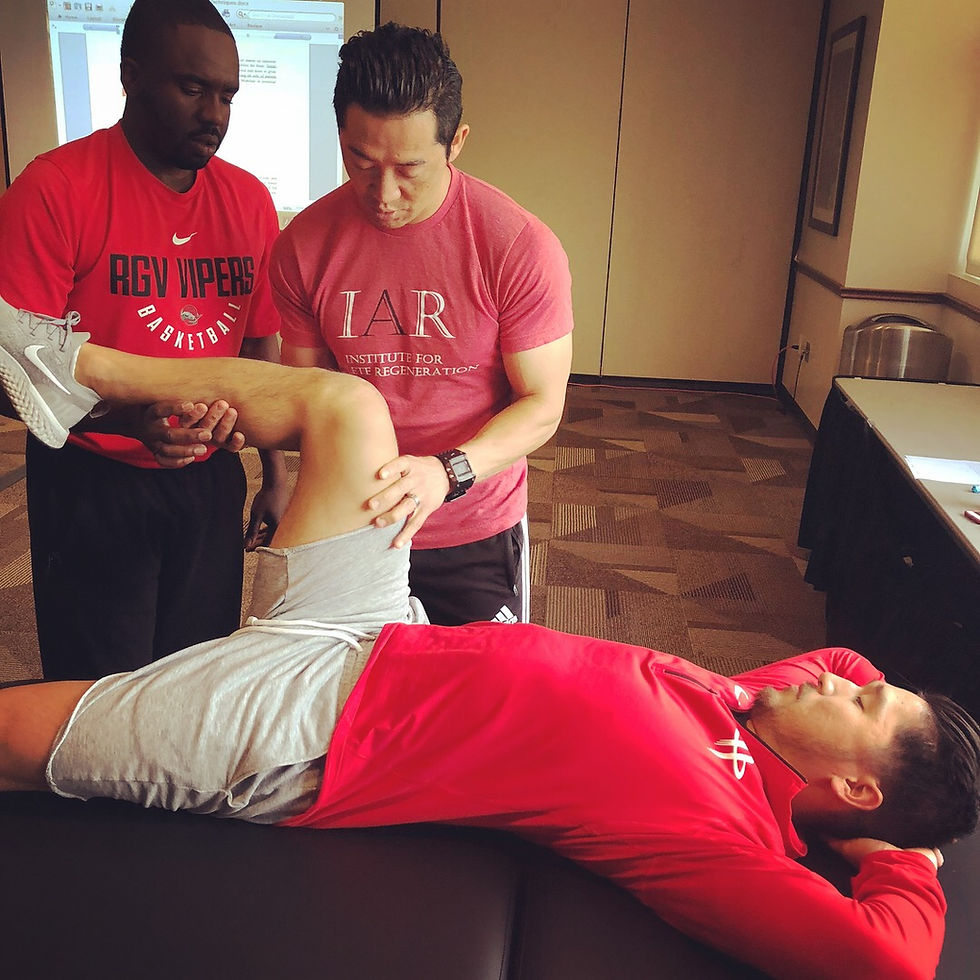
Manual therapy is most powerful when it is directed by assessment rather than delivered by habit. Within a movement-centered framework, manual therapy is one piece of the treatment process, selected deliberately because the assessment identified a restriction or sensitivity that is limiting movement quality.
The sequence matters. Movement assessment identifies where the system is breaking down. Clinical reasoning determines whether a manual intervention is the right tool for that finding. Treatment is applied with a specific, testable intent. And then the movement is reassessed.
That reassessment step is where average treatment becomes precise treatment. If a manual technique meaningfully changes the movement pattern, the clinician has confirmation that the targeted restriction was relevant, and a newly opened window to load and retrain the improved pattern. If nothing changes, the hypothesis gets revised. Either way, the clinician learns something concrete.
This creates a continuous feedback loop between assessment and intervention. Assess, treat, reassess, retrain. Sports manual therapy practiced inside that loop stops being a collection of techniques and becomes part of an integrated clinical system, which is exactly how the best sports clinicians practice.
Why Advanced Clinicians Prioritize Movement-Based Assessment
Watch experienced sports clinicians work and a pattern emerges. They spend proportionally more time on assessment than their less experienced colleagues, and their treatment looks more efficient because of it.
Movement-based assessment makes clinical decision-making faster and more accurate, because hypotheses are formed early and tested systematically rather than discovered through trial and error. It makes treatment more precise, because every intervention has a defined target and a measurable movement outcome. It makes complex athletic presentations manageable, because multi-region, multi-factor cases become organized problems rather than overwhelming ones.
And it improves long-term outcomes, because athletes leave care with the underlying movement drivers addressed rather than temporarily quieted. For performance-minded athletes, that same process frequently uncovers inefficiencies worth correcting even in the absence of pain, which is why movement assessment sits at the intersection of rehabilitation and performance.
Better Assessment, Better Decisions, Better Outcomes
Movement-based assessment provides what symptom-focused evaluation cannot: insight into why an athlete's system is breaking down, not just where it currently hurts. That insight sharpens every downstream decision, from intervention selection to exercise progression to the return-to-sport call itself. In athletic populations, sports rehabilitation built on a movement-centered approach is not a stylistic preference. It is the standard that complex cases demand.
This integrated model sits at the center of the Sports Manual Therapy Certification (SMTC) through IAR Education. The SMTC trains clinicians to combine movement analysis, manual therapy, and clinical reasoning into one coherent system built for athletic populations, with an emphasis on practical skills that transfer directly into Monday morning practice. For clinicians who want their hands and their reasoning operating at the same level, it is a natural next step.
Clinicians focused on running athletes will also find direct overlap with the Running Rehabilitation Specialist (RRS) certification, where gait-specific assessment and correction are developed in depth.
For more clinician-facing education on assessment, clinical reasoning, and sports rehabilitation, visit the IAR Resource Center.

Comments